Until the summer of 2024, I was the default parent who got the calls. The one who would need to grab any one of the kids who was sick or needed last-minute school supplies for a project that skipped their little curious minds.
Back then, I was a stay-at-home dad, much like traditional stay-at-home motherhood roles, with the audacity of starting my blogging business and juggling a few Airbnbs with the kids’ full-time school schedules as the default parent, which is a full-time job in itself.
Do not let anyone fool you; it is a full-time job, especially when having to regulate big emotions in my boys.
There was not one day that I realised I wasn’t the go-to parent anymore. It was way more drastic than that. We separated in a big way, which was a huge realisation that I wasn’t that parent anymore.
I came back to the United Kingdom, and they went to the East Coast of the United States, which is quite a distance, I might add. There was no way I could be the default parent anymore, but my parenting style changed amid the shift in family dynamics, positioning their mother as the primary breadwinner.
What’s the default parent, you ask? The parent everyone relies on first, the one holding the mental or physical load. The keeper of the calendar, the shoe sizes, the snack rules, the field trip forms, and the invisible “don’t forget” list running in their head all day.
If you’re living through not being the default parent anymore, let me tell you straight up and down: this shift may be ok for some, but for me, NO.

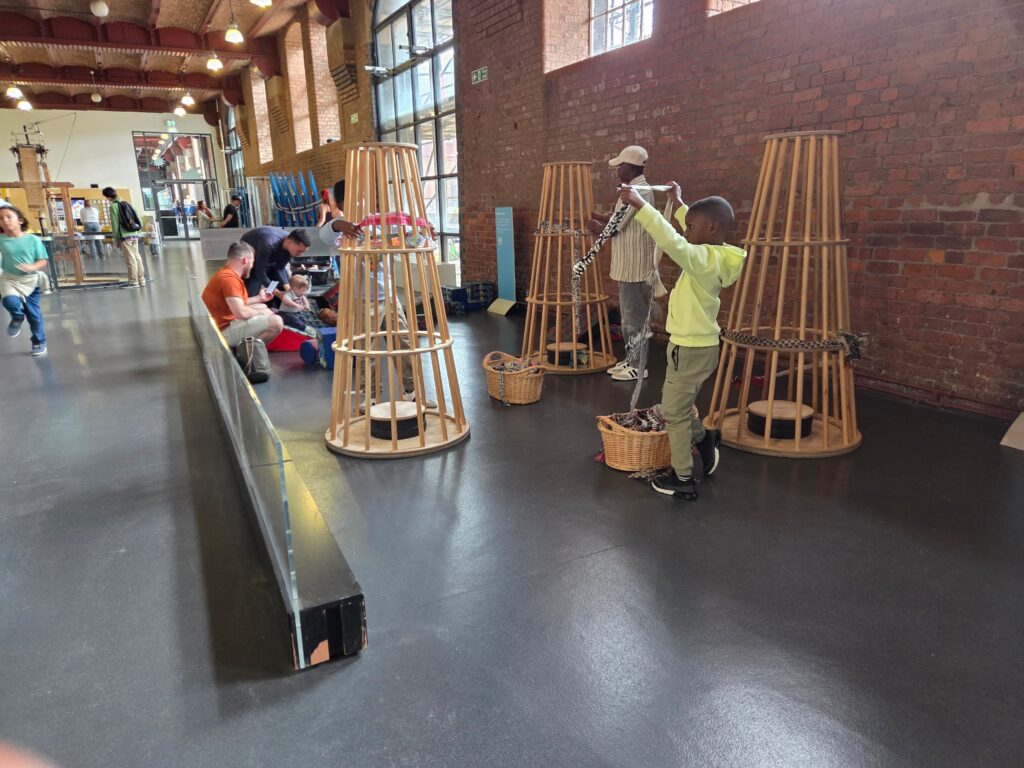
A very informative visit to the Manchester Science and Industry Museum.
What’s Changed in the Roles
The shift came with the logistics, the invisible load of who handles household tasks like packing lunches, booking the dentist, and remembering Spirit Week. Identity is the quieter question, the cognitive labor and emotional labor I hate admitting: If I’m not the default parent doing it all, who am I in this family?
For me, the change came with the separation. I wasn’t the default parent being asked and harassed anymore. Bedtime happened without my running commentary.
I received fewer helpless lines like “please tell me what to do,” and more confident sentences like “I already sorted it.”
Sometimes the shift is short-lived. A new work schedule, a bout of illness, a custody change, a burnout crash. Many working moms experience this. Other times it lasts, a true rebalance that becomes the new normal.
Either way, it doesn’t mean I messed up. It means our family system is evolving, and we must adjust to it, and it’s most definitely allowed to.
Signs I’m not “on call” for everything anymore
These were my clearest tells:
- Fewer school pings and school drop-off coordination to me: The nurse calls the other number first.
- The other parent knows details: Teacher names, shoe sizes, the child’s basic needs, like allergy notes.
- Appointments happen without reminders: Not just booked, but followed through.
- My kids accept comfort from them: Not as a backup hug, but as a real safe place.
The mental load is the real story
Chores are visible. The mental load is the backstage crew.
For me, it’s missing all the daddy duties that I complained about, and the responsibilities I frowned upon, I miss them more than I thought I would.
It’s tracking growth spurts, permission slips, medications, birthdays, and the one weird sock a child will only wear when they’re anxious.
That’s why the change is the most unsettling. My mind has been trained to anticipate problems and find solutions if or when they arise. Letting go isn’t just emotional, it hits your body as well.
For more insight into Psychology Today’s overview of “default parent syndrome”.
The Mixture of Relief and Loss
Two things can be true at the same time, and they share the same room. They can sit side by side at the kitchen table.
This might sound like a biased opinion, but my partner does the best job raising our boys. Even with that said, the darker thoughts still slip in, weighing on my mental health with the emotional pull of separation from the default parent role.
If they can do it fine, was I even needed? That’s an illogical feeling, old wiring at best. It’s the internal loss of identity that comes with no longer being the default parent.
Being needed can feel like safety, and then it shows up with a chore list instead of love.
And when I step back, another fear raises its big head: If I’m not present, will things fall apart? This fear is how control disguises itself as care. Over-functioning becomes a role, then your identity, then a habit that feels like morality and leads to burnout.
That is how fathers feel lost without their family, or kids to be specific. It’s a paternal mirror to the motherhood experience, compounded by gender inequality in how we perceive parenting roles. Ambitious women often shoulder these weights too.
I think about you sometimes, Dad. How you carried your own quiet loads of invisible labor. How you showed love by showing up, again and again, even when nobody applauded you for it. I wonder if you ever felt replaced when we grew up and didn’t need you in the same way.
Relinquishing control can feel like a risk, even when it’s healthy
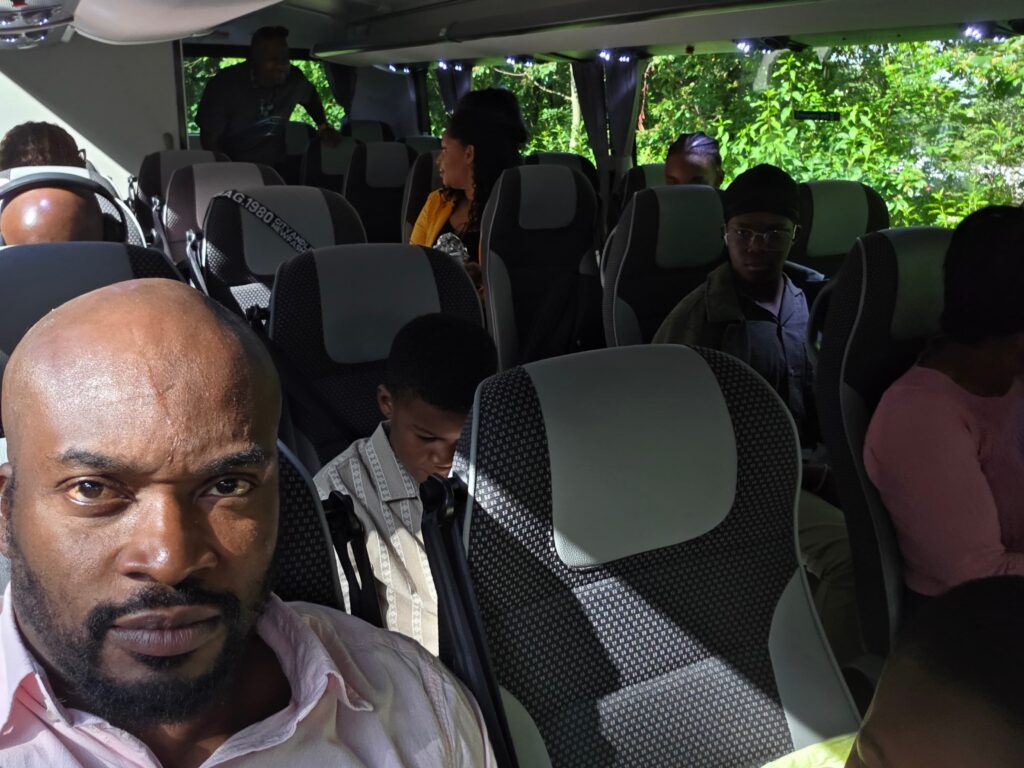
Taking the boys to London for the 30th anniversary, marking the loss of my mum and aunt in the Montserrat volcano, was deeply meaningful. It was an absolute privilege to have them experience that moment with me, the closest connection they have to their grandmother.
When I Stopped Managing and Started Trusting
If I don’t change how we do things, I’d still end up running the show, just from a distance. I’ll be the quiet investor, keeping tabs on everything, ready to jump in and fix it. That’s not a real balance. It’s the same role, just dressed up differently.
The ownership model offers a real solution to the distance parenting struggle.
Ownership means one person fully carries an area, including planning, follow-through, and problem-solving. It’s not “helping.” It’s not delegating tasks. It’s not “tell me what to do.” It’s “this is mine.”
This is actually what many families do: living together, separated, blended, or long-distance. The goalpost changes, but ideologies remain the same.
When co-parenting across homes, partner support and clear communication are a must; there is no space for assumptions to multiply in silence.
Allowing the present parent to lead.
In our situation, I lead the flock when they visit during the summer and at any other time.
My partner handles all the day-to-day household responsibilities, logins, forms, follow-ups, and complaints because we have all boys. I don’t hover. I don’t “just remind you.” I don’t take it back because it’s done differently than I’d do it.
A script that’s worked for me to transfer ownership:
At this point, I’m working on stepping out of the default parent role. Can you take full ownership of the school this month, from start to finish, including all parenting decisions? That means emails, forms, supplies, and follow-ups. To transfer ownership fully, if it’s yours, I’ll mentally unload it and focus on other stuff. This helps define our parenting roles.
A simple weekly check-in keeps us synced
We keep it to 10 to 15 minutes. Any longer and it turns into a meeting I’ll resent. Lol, I kid, of course.
Our simple agenda reinforces the ownership model:
- What’s coming up this week?
- What worked last week?
- What felt heavy?
- What needs a decision?
Whatever needs tweaking is done then and there.

Gym days
Taking Care of Dad
I’ve learned not to fill it with more chores. What I do is read and write, helping me balance career and life while rediscovering a new sense of purpose. I share some tidbits that I have learned from parenting from afar.
If you’ve been running on fumes, that empty space might be your first warning sign that you were close to a wall.
I’ve written before about how burnout can warp your sense of self and affect your mental health, and I still come back to managing parental burnout while parenting from a distance when I need a reset.
This new setup lets me divide leisure hours for self-care, even as kids will most likely test it, with some pushback from both sides of parenting necessary. They may still call for me out of habit.
They may get upset when I stop jumping in to fix it. That doesn’t mean the change is bad, it just means they feel and recognise it.
Connection doesn’t have to be logistical, like handling a child’s basic needs. It can be small and in different doses.
Parenting changes, much like the motherhood experience, and so does the way we’re needed. I’m learning that staying connected doesn’t always mean being central, loud, or in control. Whether you’re a working moms or an ambitious woman handing off duties, it applies.
Sometimes it looks like presence without pressure, trust without hovering to relinquish control, and love that adapts instead of tightens. I’m still here, still Dad, just showing up differently and choosing to stay close anyway. Reading and writing continue to help me balance career and life in this shift.
This week, I’m choosing one area to hand off fully with partner support, and one small schedule tweak with each child to protect our closeness. I’m allowed to share the load and still be important.



4 Comments
Comments are closed.