When kids ask, “What can we do for entertainment?” Do you..?
- Stop what you’re doing and interact?
- Use screentime as a babysitter? or
- Make this a lesson for Imaginative play ideas.
Ding ding ding, number 3 is correct.
During early childhood, when children have the time and freedom to be creative, they spark curiosity, build attention to detail, and create a safe space to express feelings.
Surviving through this newfound boredom comes with new thought processes and actually feeling what’s going on inside without pressure or rules.
A child who isn’t afraid to be alone is a superpower.
Everything Sparks a Kid’s Creativity
Pretend play is when your child pretends, simple as that.
Creativity is when your child makes something new by pretending, often through make-believe.
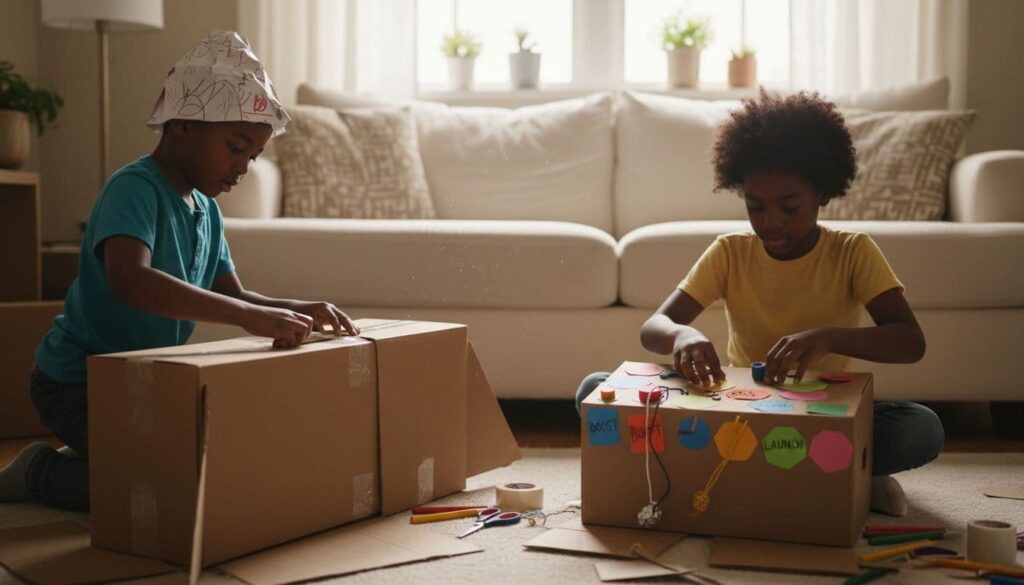
A quick example: if a toddler says a cardboard box is a spaceship, that’s imagination. They would cut “control panels” from paper, tape buttons on top, and decide it runs on “moon cookies,” that’s creativity showing up, too.
Both matter, but imagination comes first; it’s the spark before the fire. It lets preschoolers try out real-life situations without the real-life stakes.
Pretend play does quite important work:
- It strengthens language development, because kids talk through what they see, think, and imagine as they play.
- It builds emotional strength because kids can act out their fears, then find a way to solve them.
- It builds social skills, because one kid plays the “customer” and another plays the “chef.”
- It helps kids stay focused because a story only works when they keep paying attention.
- It turns boredom into something helpful because it opens a door instead of blocking them.
It fits right in with sensory play and gives kids space to let their imagination take full control.

When imagination looks like “Nothing” but it’s “Everything.”
As a parent, screen-free quiet usually means suspicion, but in this case, not so much so.
Quiet doesn’t mean nothing is happening.
Sometimes a child may be sitting with a toy and hardly move, but you can still feel the story happening in their head.
It may not look like much, but look for these signs:
- They do role-playing (teacher, doctor, baby, superhero).
- They make sound effects (sirens, animal noises, whispers).
- They use object substitution (a spoon becomes a microphone).
- They talk to toys, or have toys talk to each other.
- They draw maps, treasures, floor plans, or “secret routes.”
- They build worlds with building blocks, pillows, couch cushions, or shoes.
- They invent rules for games (and defend those rules very well).
Screen-free quiet time can be good for kids. It gives their mind a quick break, then their imagination kicks in and starts building a story.
Ways to Protect Creativity Before It Fades
I remember coming home with homework as a child, and my dad was over my shoulder like a hawk. That pressure was immense, and I would shut down every time. My thinking clearly was out the window.
I do not do that to my boys;
Perfection pressure. Kids quit when they feel like they can’t do it the “right” way.
Fix: I tell them, “Try your best, and we’ll fix it together.” I mean it.
Too many toys. Too many choices can overwhelm kids, and all that stuff starts to feel like background noise.
Fix: Pack most toys into a closet and keep a small, simple set out.
Constant instructions. Kids start to depend on step-by-step directions, and they pause and wait for the next move.
Fix: I replace instructions with simple prompts like, “Show me what you’re thinking,” and “You choose what happens next.”
Rushing. Imagination needs a little breathing room.
Fix: I guard 10 minutes a day for open-ended creative play, even when the day is packed. I set a timer, put my phone down, and don’t “help” unless they ask.
Creativity Without a Mess or Cleanup Plan
Anytime I’m supposed to plan for a mess, I freeze. If paint, slime, or glitter is part of the deal, my brain wants to bail. I’m working on that, and I’ll get better at it, but for now, let’s keep going.
Here’s a quick menu for setting. Each has a one-sentence prompt you can say to start.
Indoors: “We’re stuck inside, so we’ll pretend the house is somewhere else, like a grocery store or play kitchen.”
Outdoors: We’re inside today, so let’s pretend our house is a brand-new place. The floor plan is our map, and we’re the explorers.
Errands: Let’s act like we’re undercover helpers with a special job to do.
Bedtime: “Close your eyes and tell me what happens next.”
If you’re into extra low-cost art materials made from household items and in need of inspiration, The Artful Parent’s budget-friendly crafts.
Rainy Days When You’re Stuck Inside
These activities build fine motor skills through drawing and writing, alongside gross motor development from building and moving.
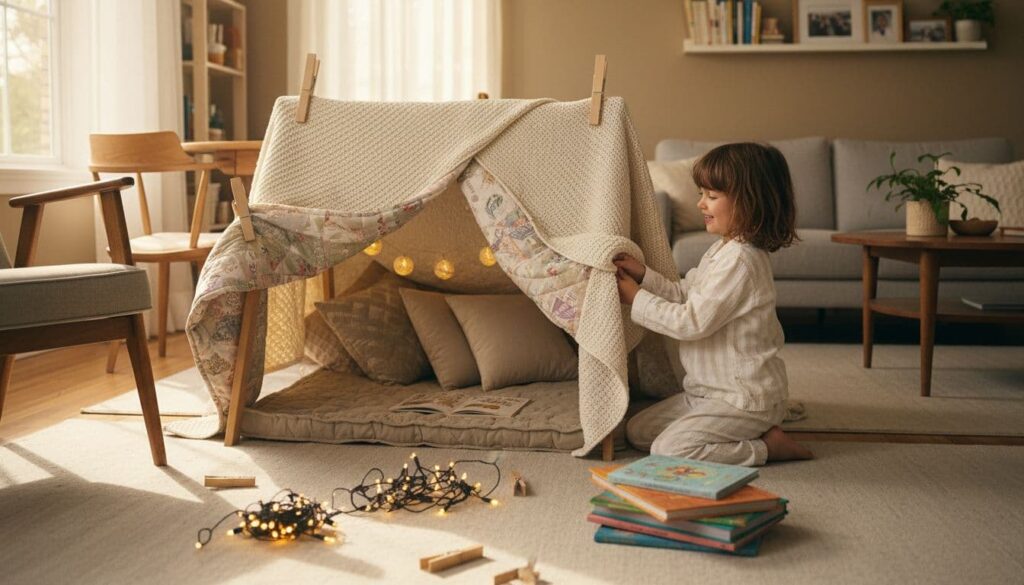
1) Blanket and or pillow fort mission control
Prompt: “This fort is mission control, what’s our job today?”
A sheet, two chairs, two pillows, a flashlight, done.
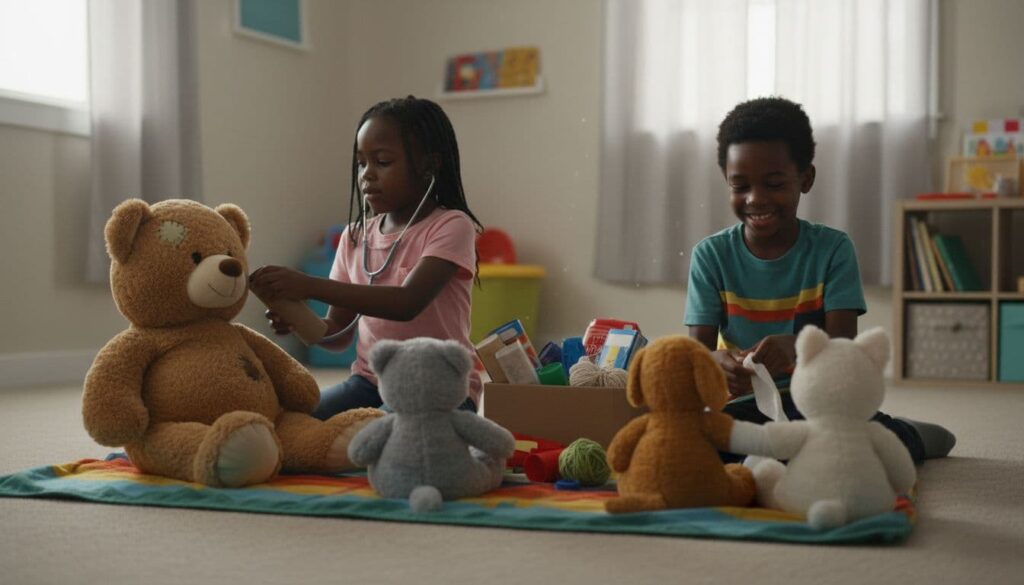
2) Stuffed animals doctor’s office
Prompt: “Your stuffed animals need help at the doctor’s office. Who’s hurt first?”
I hand them paper “forms” and a pencil for check-ins with the stuffed animals.
3) Restaurant with handwritten menus
Prompt: “Welcome to your restaurant, what’s on the menu?”
They write, draw, or scribble. I “order” with full seriousness.
4) Mystery box storytelling (3 random items)
Prompt: “These three things belong in one story; tell me how.”
Grab a sock, a spoon, and a toy car, and let them connect them.
5) Sock puppet show
Prompt: “Your puppet has a problem. What is it?”
Kids love giving the puppet feelings they won’t say out loud.
6) Cardboard city
Prompt: “This box is a building, what happens inside?”
I don’t cut perfect windows. I let tape and markers do the work.
7) Tape roads for toy cars
Prompt: “We need a road to the airport. Can you build it?”
Painter’s tape or masking tape works. Kids love a “route.”
8) Invent a new holiday
Prompt: “We’re making a holiday, what do we celebrate?”
They decide the name, rules, and a small symbol to draw.
My parenting tip: To keep the mess to a limit, I stick to three simple rules: put a towel under the activity, use a tray when I can, follow a one-bin rule (everything goes back into one container when we’re done), or try sensory bins for contained play without massive messes.
Is a Walk Ever Just a Walk?
1) Nature scavenger “find” list
Prompt: Let’s spot five things that feel like they came out of a story.
The fun part is they pick the categories, not me.
2) Pirate treasure map with landmarks. Prompt: “That tree is the lighthouse, so where did the treasure go?”
They sketch a simple treasure map, then we walk it out together.
3) Cloud story spotting. Prompt: “That cloud is a character, what’s their name?”
This one can take 10 minutes or stretch into an hour.
4) Sidewalk chalk portal game
Prompt: “Step into the circle and you’re in a new place. Where are you?”
Each chalk “portal” has a rule, like “talk like a robot.”
5) Stick wizard wand training
Prompt: “Your wand can only do one kind of magic. What is it?”
Limiting the magic makes the story stronger.
6) Backyard campsite role play
Prompt: “We’re camping tonight. What do we need to survive?”
A towel becomes a sleeping bag. Leaves become “food.”
7) Bug detective notebook
Prompt: “You’re the detective, what clues do you see?”
We don’t touch unless it’s safe. We observe and draw.
8) Sound safari
Prompt: “Let’s hunt for five sounds, then name them.”
A car door becomes “the giant’s shield,” and birds become “messengers.”
Safety matters more than the story. I set clear boundaries, stay within sight, use sunscreen, and bring water to build healthy habits. If kids are little, I also keep small items out of reach and supervise closely.
Plant the Seed and Step Back
I’ve learned a hard truth: the fastest way to kill pretend play is to make it my project.
Kids want ownership. They want to be the author. My role is more of a stagehand; I set the scene and let them do what they do best.
What I Say When I’m Not Sure What to Say
- “Tell me what happens next.”
- “Show me how it works.”
- “What should I be?”
- “Do you want help, or do you want me to watch?”
- “I like your idea.”
When I need to guide, I use “yes, and” instead of “no.”
If they say, “The couch is lava,” I don’t argue. I say, “Yes, and we need a safe path.”
What are the questions to ask?
I keep questions simple and open to spark critical thinking:
- “What’s the problem in this story?”
- “Who’s coming to help?”
- “What rule should we make?”
If siblings fight, I don’t pick a winner. I narrate the problem and offer two choices: “Do we take turns being the boss, or do we split the game into two teams?” It’s not perfect, but it moves us forward while building social-emotional skills.
Meeting Kids Where They Are and Not Vice Versa
Shy kids: I start with parallel play. I sit nearby and copy quietly.
High-energy kids: I build movement into the story with real-world roles (missions, deliveries, rescues).
Easily frustrated kids: I give them a “reset role,” like timekeeper or map holder.
For neurodiversity-friendly play, I keep routines predictable to support executive function and prompts clear. Visual cards can help (draw a quick “character,” “place,” “problem”). If sensory needs are strong, I adjust the environment: dimmer light, fewer sounds, a heavy blanket, or a small fidget during story time. If you want more on the emotional side of pretend play, Child Mind Institute’s piece on pretend play puts words to what many parents feel.
Dad, I wish you could see how different each kid is. You’d have loved that. You always noticed the quiet details.
Distance Doesn’t Have to Mean Disconnection
Not every parent has time to sit on the floor. I’ve had seasons where I was physically present but stretched thin. That doesn’t mean I couldn’t join the play for toddlers and preschoolers.
These are “from afar” ways I stay connected while cooking, working, or catching my breath:
Voice-only roles: “I’m the dispatcher. I’m sending you a mission.”
Sticky-note surprises: I leave a note that says, “New rule: the floor is ice.”
Two-minute check-ins: “Show me the coolest part so far.”
Soundtrack support: I play rain sounds, space sounds, or jungle sounds.
Photo proof: “Take a picture of your finished world.”
Small touches tell a preschooler or toddler, “I see you.” When I miss my father most, it’s because I want someone to see me like that. So I try to give it to my kids now, while I can.
How Independence Grows When Kids Are Given Space
Confidence grows when toddlers feel capable, not when they’re praised nonstop.
These pretend play ideas help my preschoolers practice being “in charge” in a safe way:
The helper job: “You’re in charge of packing our explorer bag.”
The problem-solver: “The bridge broke, what’s your plan?”
The teacher role: “Teach me the rules like I’m new here.” (This builds their communication skills.)
The builder’s choice: “Pick three materials, that’s all you get.”
The storyteller said: “You start the story, I’ll follow.”
If you want a simple list of pretend play prompts for different ages, Pathways.org has a helpful set of pretend play ideas that line up well with this confidence-first approach. This dramatic play ultimately strengthens bonds and fosters growth in toddlers and preschoolers.
If you’re walking a similar road, you’re welcome here on our Fatherhood Uncut Facebook Page. Stay connected and read along as I keep figuring this out in real time.


2 Comments
Comments are closed.